


For broader advice on materials, lids and carrying features, see how to choose a gym water bottle
Why Capacity Does Not Tell You Whether a Bottle Will Fit
Millilitres and litres describe how much liquid a bottle holds, rather than its external dimensions. Two bottles with the same stated capacity may have different widths and heights because of their construction, body shape, lids and handles.
A tall, narrow bottle and a shorter, wider bottle can therefore fit different pockets or holders even when both hold one litre.
Capacity remains useful when deciding how much water to carry. If you need help understanding volume labels, our guide to water bottle capacity conversions explains ounces, millilitres and litres. Those conversions do not establish physical fit.
For compatibility, compare the bottle’s external dimensions with the usable space in your bag or exercise-machine holder.
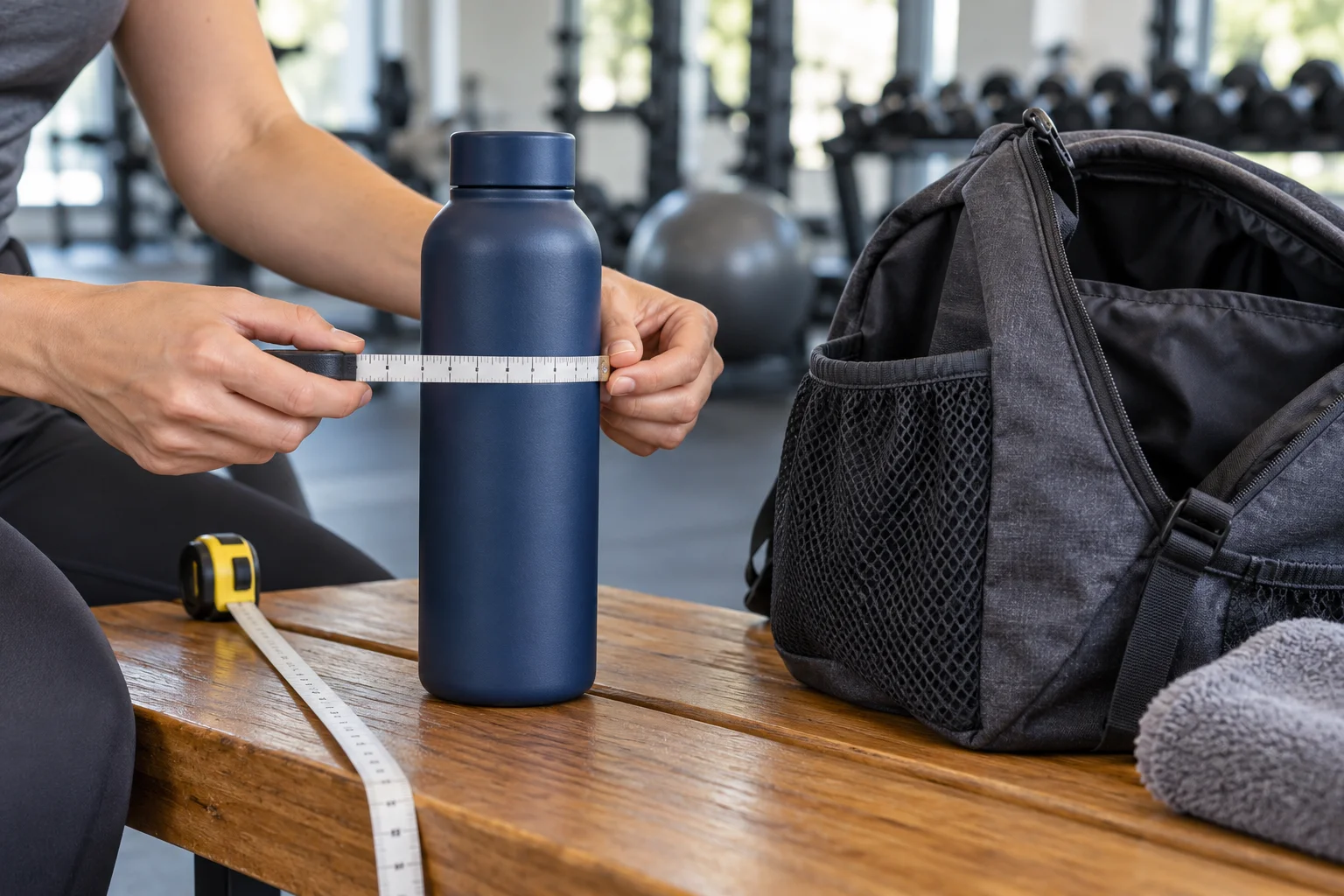
Which Bottle Measurements Should You Check?
Check these measurements separately. The base is not necessarily the widest part of the bottle.
Measurement | What to check | Why it matters |
|---|---|---|
Base diameter or width | The external width across the bottle’s bottom. For non-circular bottles, check width and front-to-back depth. | Helps assess whether the base can enter and sit within the usable space. |
Widest body width | The widest external section, including shoulders, grip bands or raised features. | A bottle may enter at the base and then catch where its body widens. |
Total height with the lid closed | From the base to the highest point of the closed lid or any fixed handle. | Helps assess protruding height, overhead clearance and access for removal. |
Handle and lid clearance | Protruding parts and the space needed to open the lid or lift the bottle out. | Handles, loops and hinged lids may interfere with fabric, straps or nearby controls. |
Swipe to see more ->
A bottle does not need to sit completely inside a pocket or holder. It can extend above the opening and still be supported securely.
Depth affects how much support the pocket or holder provides. Total bottle height affects how far it protrudes and whether there is enough room to handle it. Neither measurement alone guarantees a stable fit.
How to Check Your Gym Bag’s Bottle Pocket
Fabric pockets are flexible, so a flat ruler measurement is a starting point rather than a definite compatibility test.
Pack the bag as you normally use it.
Packing can change the usable space in side pockets. Check the bag with your usual gym items inside.Inspect the opening and pocket shape.
Look at elastic, seams, retaining straps and available space. Do not treat the width of a flattened fabric opening as an exact internal diameter.Compare the bottle’s base and body dimensions.
Consider both the opening and the space below it. A narrow base may enter while a wider body or handle catches.Test with an existing bottle where possible.
A bottle with known dimensions can help you understand how the pocket behaves. Check how it sits when the bag is upright and during normal carrying.Check support and access.
The pocket should hold the bottle securely while allowing you to remove it without a struggle. Check for interference with zips, straps and nearby compartments.Avoid forcing the bottle into place.
A fit that requires excessive stretching or pressure may damage the pocket and make the bottle difficult to use.
A bottle extending above the pocket is not automatically a problem. What matters is whether it remains supported and whether the exposed height interferes with carrying or accessing the bag.
How to Check a Treadmill or Exercise Bike Bottle Holder
A rigid holder may have a wide opening but narrower space lower down. Inspect the inside rather than judging compatibility from the top alone.
Check fit, insertion and removal while the machine is stopped, and follow its manufacturer’s safety instructions.
Inspect the holder’s opening and internal shape.
Note whether it is circular, shaped differently, open-sided or lined with ridges.Measure the usable space.
Check the internal opening and any narrower sections. For a non-circular opening, consider both width and front-to-back depth.Check taper and support depth.
A holder that narrows towards the bottom may stop the bottle from reaching its intended resting position. Depth also affects how much of the bottle is supported.Look for nearby obstructions.
Consoles, rails and controls may restrict space around the lid or handle, or make removal awkward.Test with an existing bottle.
With the machine stationary, check insertion, resting position and removal. Do not force the bottle into the holder.Assess how the bottle sits.
It should rest securely in the holder’s intended position without tipping or interfering with nearby controls. Some holders are angled, so perfectly upright placement is not always required.
If you use shared gym equipment, check the machines you normally use. Do not assume every treadmill or exercise bike has the same holder.
Bottle Design Features That Can Affect Fit
Dimensions are the starting point, but individual design features can also affect compatibility.
Feature | Possible effect on fit | What to check |
|---|---|---|
Slim or wider body | Changes the space available around the bottle. Neither shape is automatically more stable. | How the body fits against the holder or pocket’s supporting surfaces. |
Shoulders or changes in width | A bottle may begin to enter and then catch where it widens. | The widest section and where it sits relative to the opening. |
Fixed side handles | May catch on an opening or interfere with straps and consoles. | Clearance during insertion, resting and removal. |
Carry loops | May protrude or snag on nearby parts. | Whether the loop is fixed, flexible or able to fold away. |
Bulky or hinged lids | May need additional space above or beside the bottle. | Closed dimensions and room for the lid’s opening movement. |
Square or oval bodies | Fit can change with orientation, and corners may obstruct insertion. | The full cross-sectional shape as well as width and depth. |
Swipe to see more ->
A wide mouth does not establish the bottle’s base width. Likewise, a flip-top or magnetic lid does not automatically mean a compact design. Check the actual dimensions and movement of the selected model.
What to Ask the Seller Before Ordering
Do not estimate dimensions from product photographs or capacity labels. Check published measurements and ask the seller to clarify missing details.
Useful questions include:
What are the external dimensions of the exact variant I am ordering?
What are the base width and widest body width?
Does the total height include the closed lid and any fixed handle?
Are protruding handles or loops included in the measurements?
Were the measurements supplied by the manufacturer or checked by the seller?
Do the photographs show the exact model and variant selected?
What are the current return conditions if the bottle is unsuitable, including packaging and product-condition requirements?
Manufacturer and seller measurements can both be useful. The important point is that they apply to the correct variant and clearly describe what has been measured.
If dimensions are missing, compatibility remains unconfirmed. That does not mean the bottle is faulty or cannot fit; it means you need more information before deciding.
A Simple Fit Checklist Before You Choose
Before ordering, check that you have:
Compared the bottle’s base and widest body with the usable opening and internal space.
Considered support rather than requiring the bottle to sit entirely inside.
Checked lid, handle and loop clearance.
Allowed room for insertion and removal without force.
Tested an existing bottle where practical.
Confirmed missing measurements for the selected variant.
Once you have checked your pocket or holder, compare gym water bottles and confirm the dimensions of your preferred model before ordering.
Frequently Asked Questions
Does a 1-litre bottle fit every treadmill holder?
No. One litre describes capacity, not external size. Fit depends on the bottle’s dimensions and shape, as well as the holder’s opening, internal space and support.
Can a bottle be taller than a gym bag’s side pocket?
Yes. A bottle can extend above the pocket and still fit securely. Check support with the bag packed, and make sure the exposed height does not interfere with straps, zips or carrying.
Is bottle capacity enough to check compatibility?
No. Check external dimensions, including the base, widest body, closed lid and fixed handles. Capacity alone cannot establish whether a bottle will fit.
What should I do if the product page does not list dimensions?
Ask the seller for the exact external dimensions of your chosen variant. Treat compatibility as unconfirmed until you have that information rather than guessing from capacity or photographs.
Can a square or oval bottle fit a round holder?
Sometimes. Width and depth alone do not guarantee fit: corners or the bottle’s cross-sectional shape may prevent insertion. Check its dimensions and actual fit, where possible, with the machine stopped.
Need help choosing the right product?
Tell us your budget and requirements. We'll recommend the best options for you.


